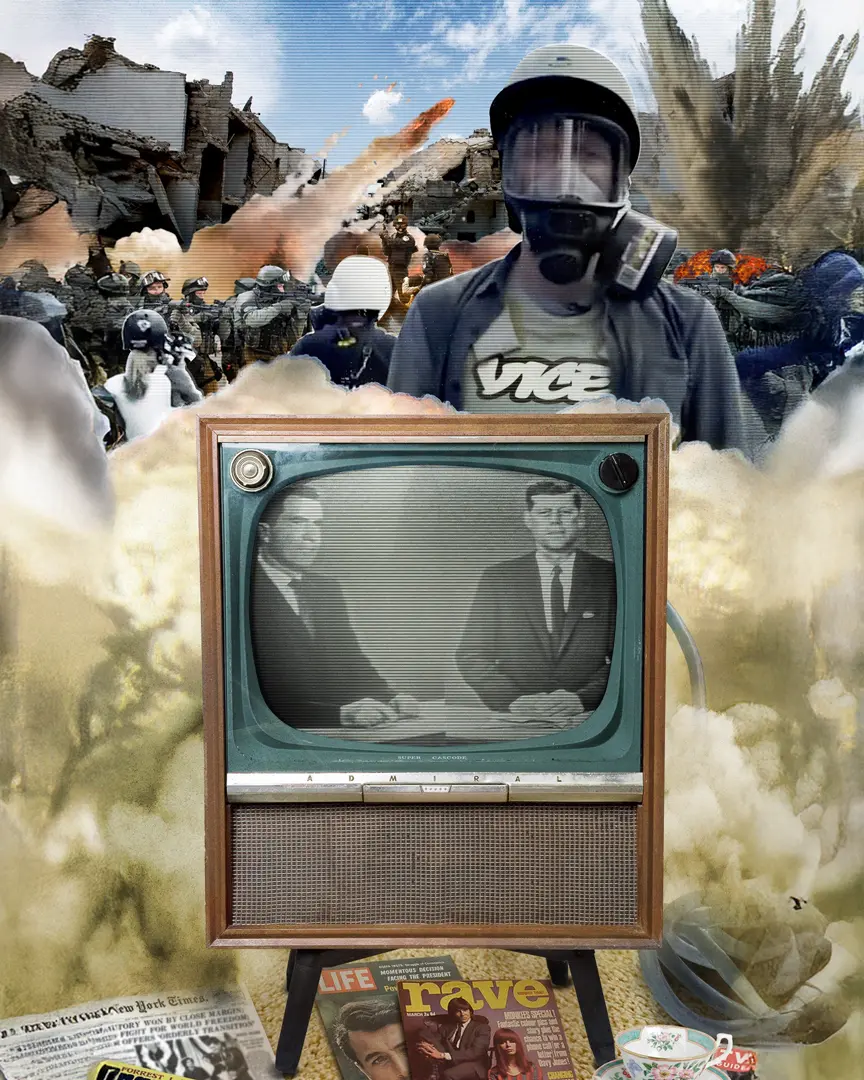
When people talk about Vice today they talk about scale and valuation. That is not how it felt to build. It felt scrappy, uncertain, and more than a little uncomfortable. Jeff Yapp saw a counterculture magazine and recognized something most legacy media executives were still protecting themselves against: a voice looking for the right platform, right as streaming began quietly breaking the rules of distribution.
Seeing the voice
Jeff had already watched on-demand behavior reshape audiences during his time at Cablevision, so when he encountered Vice he did not see a magazine trying to become television. He saw a voice that needed a new delivery system. Inside the company, Eddy Moretti, who had come in with an NYU film background and was running Vice Films, was treating video as a storytelling discipline rather than a format, collecting raw, immersive documentary footage from fearless young reporters like Ben Anderson. When Jeff watched an eight-minute reel with that tension between irreverence and seriousness, he knew immediately. As Eddy later described it, Jeff saw the voice and validated it by banging his fist on the table with excitement.
The proof of concept nobody would insure
One of the earliest experiments was The VICE Guide to Travel, built deliberately lean, on roughly a tenth of a normal production budget. The real risk was not money. The crews went into volatile places, including Pakistan, with minimal infrastructure and no traditional safety net. Viacom pushed hard on security, and there were serious internal conversations about liability and brand risk. Traditional television would never have approved those trips. The insurance alone would have killed them. But Vice went, deliberately, and paired that danger with genuine absurdity, like searching for dinosaurs in the Congo. That blend of existential reporting and wild curiosity became the brand's DNA.
When it got real: Heavy Metal in Baghdad
Out of those experiments came something none of them fully anticipated. Vice had written about an Iraqi heavy-metal band, Acrassicauda, young musicians playing Western metal in Baghdad after the fall of Saddam Hussein, and helped them stage a sold-out show. When filmmakers returned a year later, everything had changed. Rehearsal spaces were gone, friends had disappeared, the city was unraveling. What began as a segment became a feature documentary about survival, filmed by a crew that was embedded and living it. That film proved Vice could carry real emotional weight, and it became the seed of Vice News: immersive, first-person, human journalism from the hardest places on earth.
Turning a voice into a business
Jeff's role was never to redefine Vice's voice. It was to build the machine around it. Banner ads were never going to sustain immersive video, so he reframed brands not as advertisers but as partners, which led to early work with Intel and Dell and to verticals built around real passions, Noisey for music, Motherboard for technology, The Creators Project for art. These were ecosystems, not ad buys. The team pushed VBS.tv as an early YouTube-era streaming play and scaled from roughly six editing bays to more than twenty. The turning point on the business side came when Tom Freston, then CEO of Viacom, leaned in, understood that MTV itself needed shaking up, and invested.
The peak, and the honest ending
At its height Vice reached more than 100 million monthly viewers, built one of the largest millennial and Gen Z audiences in digital media, earned Emmy and Peabody recognition, expanded from print to digital to streaming to cable with the launch of Viceland, and carried a valuation north of $5 billion. Eddy Moretti has said plainly that without Jeff Yapp the company would not exist. Vice later declared bankruptcy in 2023, and Jeff does not hide from that. His involvement was in the founding and the scaling, not the later financial story, and his read on the ending is characteristically clear-eyed: disruption and sustainability are not the same thing, and a brand has to evolve as fast as the culture it serves. What Vice proved still holds. Authenticity can outperform polish, distribution strategy matters as much as content, and audience trust is built through proximity, not perfection.
The habit that made it possible
One more thread runs through the whole story. Jeff heard no more than once, on Vice and on the deals inside it. His rule, earned here, is that no usually means not yet, and that innovation rarely fails because the idea is wrong. It fails when the person carrying it quits before the alignment arrives.