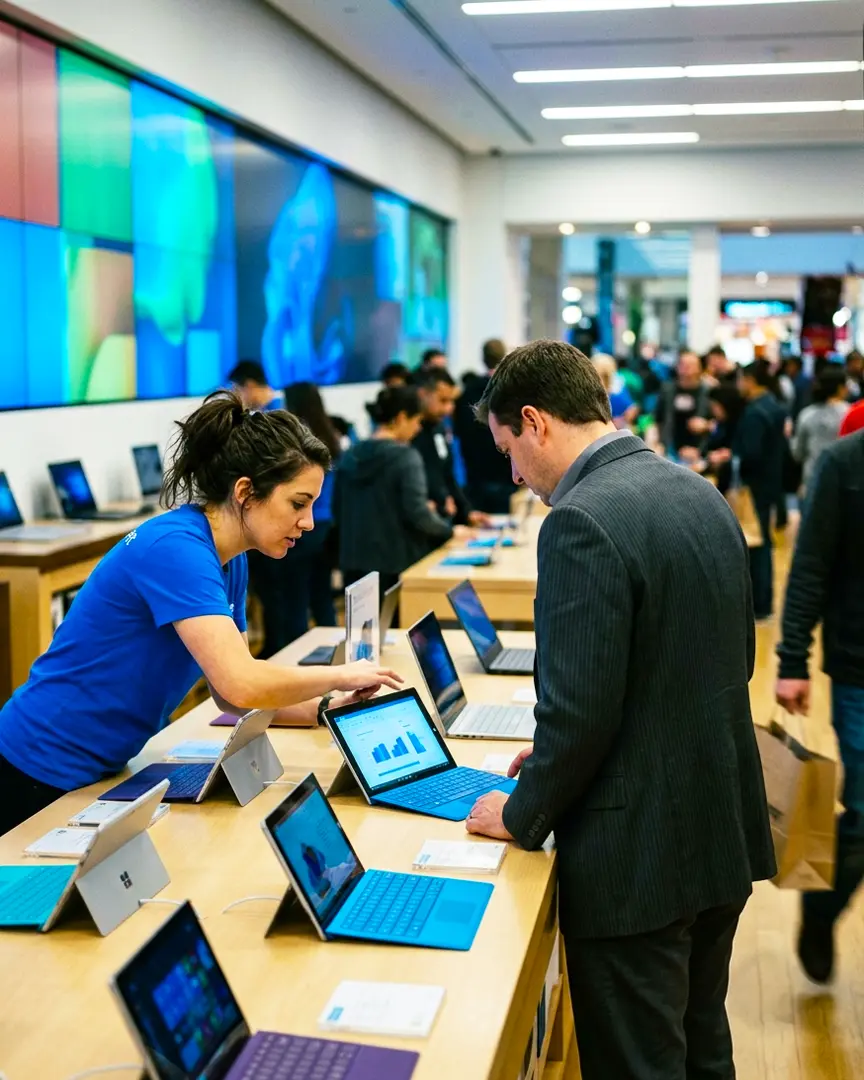
When WutzNxt started with Microsoft's Direct Sales and Support division, the company was one of the largest technology businesses on earth and still did not have a workable way to reach small and medium companies. It ran 228 online stores and more than 100 physical locations, yet on the question of serving business customers it had fallen behind. The internal consensus was that the store network was a consumer channel and always would be. WutzNxt disagreed, and then proved it.
The problem nobody had cracked
The retail footprint existed, but it was pointed at consumers buying laptops and Xboxes. Reaching businesses meant solving several things at once: international expansion across China, EMEA, and the APAC region, a shortage of internal people with the right skill set, a market moving fast under pressure from both competitors and Microsoft's own partners, and an organization that had never built the muscle for a B2B supply chain, defined commercial offers, or a clear value proposition for a business buyer. It was less a marketing gap than a business-model gap.
Reframing the store
WutzNxt helped Microsoft stop thinking of the store as a consumer website with a door attached and start treating it as an omni-channel business. The work combined several kinds of customer research with structured creative sessions to find the insight, then turned that insight into a value proposition, a market rollout plan, and a distinct brand personality for the business-facing experience. Offers were built for how companies actually buy: exclusive bundles, cloud services, and professional training rather than shrink-wrapped boxes.
600 percent, in under six months
The strategy produced a path to 600 percent incremental revenue in less than six months. A refreshed small-business store experience rolled out across 19 regions. The plan carried a full timeline for international expansion, and it worked at the edges of the map as much as the center.
Sydney and China
WutzNxt spearheaded the first Microsoft flagship store outside North America, in Sydney, and beat the launch forecast by more than 250 percent. It directed the retail expansion into China with 19 stores, which delivered one of the highest returns on investment of any retail bet in the company's history. When existing retail partners could not cover the ground for the Surface launch, the team stood up a wave of pop-up stores across the United States in a matter of months to carry it.
From boxes to the cloud
The deepest shift was the one everyone said could not happen. WutzNxt led the move from physical to online selling, from consumer to commercial selling, and from hardware to software and cloud. Cloud services went to market through retail stores at a moment when the prevailing belief was that retail could not sell cloud at all. Commercial revenue grew to represent 60 to 70 percent of store revenue, and during the pandemic the model shifted to fully commercial. In total the effort scaled into a $350M cloud-through-stores business across more than 40 hubs, 600 sellers, and roughly 500 promotions.
Still building together
That relationship did not end with the stores. It is the same partnership that today puts WutzNxt inside Microsoft's agentic AI commercialization work. The throughline is simple: WutzNxt keeps finding the businesses Microsoft's own scale cannot reach, and builds the way in.