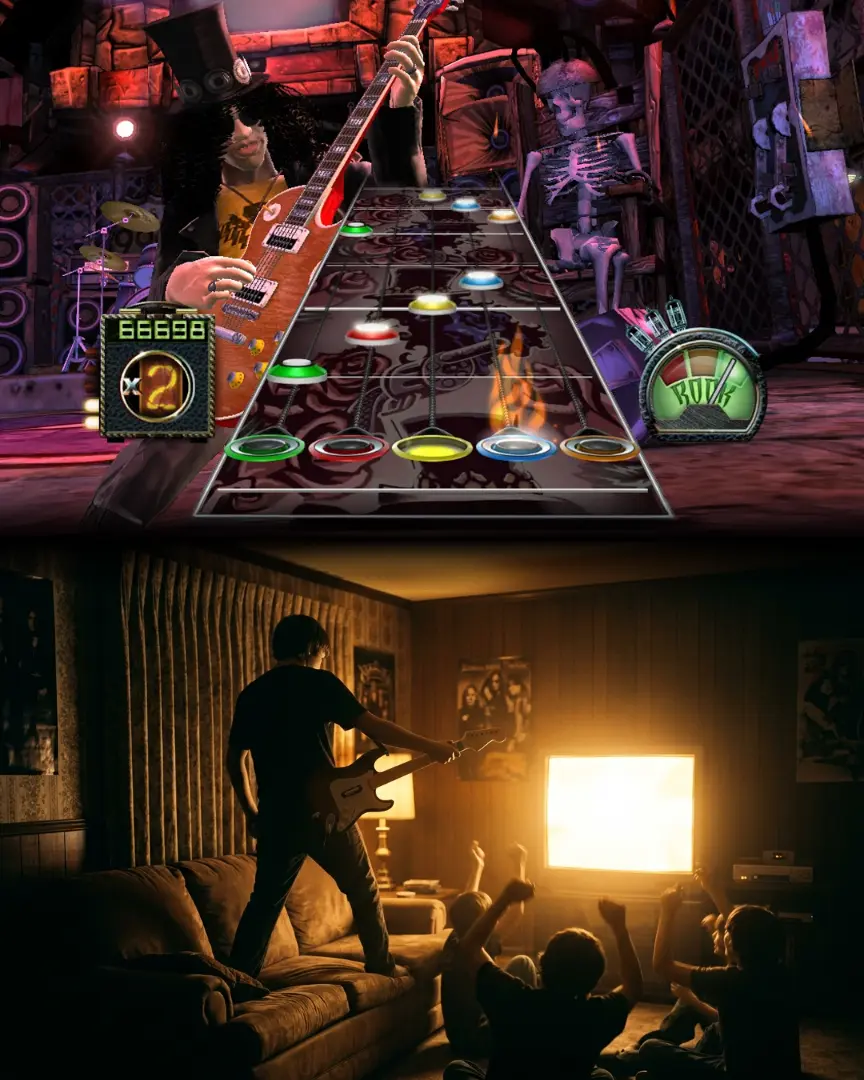
The biggest opportunities rarely announce themselves. This one was sitting in the back of the CES show floor in Las Vegas, among the small startup booths nobody was crowding around. That is where Jeff Yapp met Alex Rigopulos of Harmonix, picked up a plastic guitar, and understood in about ten seconds that he was looking at a new category.
Permission to perform
What Rigopulos showed him broke every rule of the industry. Gaming at the time meant sports, action, racing, and shooters. Music was something you listened to or watched, not something you did. This was different. A plastic guitar and a screen let anyone, with zero musical training, feel the rush of performing on stage. It did not simulate playing an instrument so much as it captured the feeling of being the person everyone is watching. That was the whole product, and it was enormous.
The deal, and the door that kept closing
Jeff structured a partnership between MTV and Red Octane. MTV brought marketing muscle and cultural reach and took a percentage of gross revenue. The idea met resistance everywhere. Major retailers would not bite. Even Walmart passed. Finally Best Buy agreed to a small test order, and, more importantly, to in-store demos. That was the unlock. The moment people picked up the guitar and played, they got it, no advertising required. The initial inventory sold out and follow-up orders scaled fast. A category was born almost overnight.
Losing the deal, keeping the insight
Success attracts company. Activision moved in and acquired Red Octane late in the process, and just like that WutzNxt and MTV were out of the deal. Rather than look back, Jeff focused on the real asset, the creators, which meant Harmonix.
The acquisition that almost did not happen
The first answer on acquiring Harmonix was no. Viacom's leadership did not yet see it. Then leadership changed. Tom Freston moved on, Philippe Dauman stepped in, and Judy McGrath backed the cultural vision. The conversation reopened, the deal moved, and Rock Band was the result.
A full band in the living room
Rock Band did not copy Guitar Hero, it evolved it. Drums, vocals, and guitar turned a solo novelty into a shared experience, a whole band assembled on a Friday night. The numbers followed the feeling. By 2008 music gaming was worth roughly $1.9 billion a year, and at its peak nearly one in five dollars spent on gaming went to the category. Guitar Hero passed $2 billion and 60 million units. Rock Band crossed a billion. Together the category generated four to five billion dollars in just a few years.
The Beatles, and 17 factories
The capstone was the one nobody thought was possible. Jeff's team earned the trust of the surviving Beatles and their families and brought the most protected catalog in music into players' hands as The Beatles Rock Band. At peak demand, 17 factories in China were producing components. Alex Rigopulos, who had shown Jeff that first demo, later put the whole thing in a sentence, praising Jeff as one of the few people at MTV who understood the potential from the start and had the conviction to act on it.
The lesson that outlived the category
The category eventually cooled. Too many titles, too little difference between them, plastic instruments piling up in closets, and a slow drift away from what fans actually wanted. That is its own lesson: a category built fast can fade just as fast the moment you stop evolving with the people who love it. But the core insight never expired. Give fans a way to participate rather than just watch, and everything changes. It is the idea WutzNxt still starts with. Find the superfans, understand exactly why they show up, and build the thing they did not know they were waiting for.